Every year, thousands of people learn just how difficult it can be to get broadband in London.
As the UK's capital, London is among the best cities in the world for business, culture, history and architecture. One area in which it lags behind, however, is reliable high speed internet access.
The problem is particularly noticeable in central London. There, historic buildings and access difficulties combine to make installing FTTP (full fibre) broadband difficult - and in some cases impossible.
While some independent broadband providers have made progress extending their networks across London, pockets of the capital are still black spots where even bare-minimum speeds aren't widely available.
How Ofcom classifies broadband speeds
Before looking at the data, it helps to know how speeds are officially graded:
Under 10 Mbps - below the legal standard for a decent home connection
Standard, up to 30 Mbps - suitable for basic web browsing, email and standard definition video
Superfast, 30 to 300 Mbps - recommended for households with several people streaming HD video or working from home
Ultrafast, 300 Mbps and above - for heavy simultaneous use, large file transfers and 4K or 8K streaming
The worst areas in London for a usable connection
Across London as a whole, the picture is better than its reputation suggests. According to the Mayor of London's connectivity map, 98.32% of London premises can access Superfast broadband, 90.82% can get a gigabit-capable connection, and only 1.34% can't reach a 30 Mbps service at all.
That London-wide average hides some sharp local differences.
In the St James's ward of Westminster, 11.22% of premises can't access a 30 Mbps service. In Upminster, in the borough of Havering, it's 10.66%. Both are roughly eight times the London average.
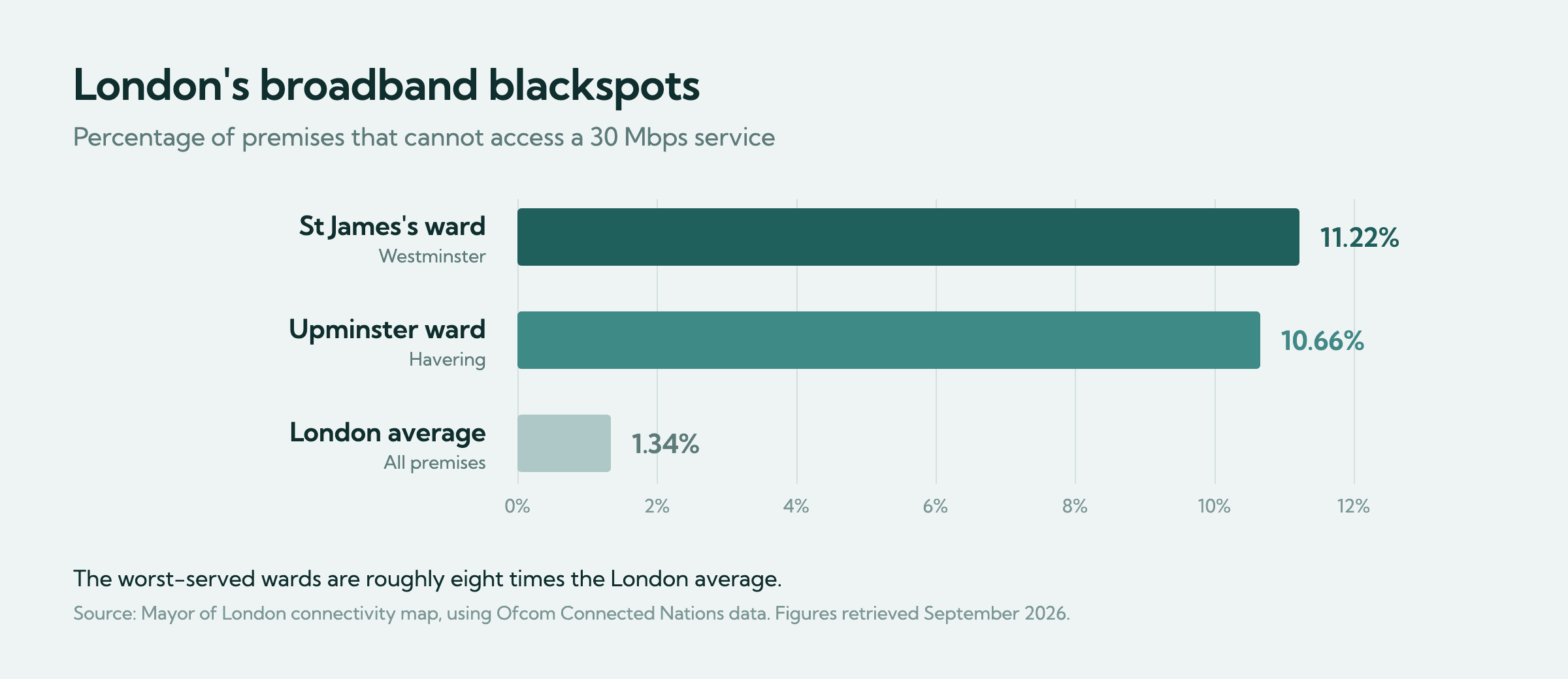
Broadband blackspots in London, by ward. Source: Mayor of London connectivity map, using Ofcom Connected Nations data.
Outer boroughs including Havering, Enfield, Hillingdon, Bromley and Kingston upon Thames all contain pockets where a usable connection is harder to come by than the London figure suggests.
One thing worth knowing if you go looking at the data yourself: full fibre availability isn't published at postcode or ward level in Ofcom's Connected Nations data, only at borough level and above. So the ward-level figures above measure whether premises can reach a 30 Mbps service, which is not the same thing as whether full fibre has arrived.
Can I get full fibre broadband in London?
At the other end of the speed spectrum is ultrafast full fibre. Speeds on these networks can range from 150 Mbps all the way up to 1 Gbps, which is 1,000 Mbps.
The demands consumers place on their home networks are continually growing. Remote working, downloading and transferring large files, 4K and 8K streaming and online gaming all need more headroom than the minimum recommendations.
Availability varies a lot by borough. In Enfield, under 60% of premises have full fibre available (59.50%), and in Barnet it's just under 70% (69.70%). Westminster, by contrast, sits at 88.30%.
Across London, 78.42% of premises can access full fibre - meaning more than one in five still can't. For comparison, the UK-wide figure is 82% as of January 2026.
Sources: Mayor of London connectivity map and Ofcom Connected Nations, Spring 2026.
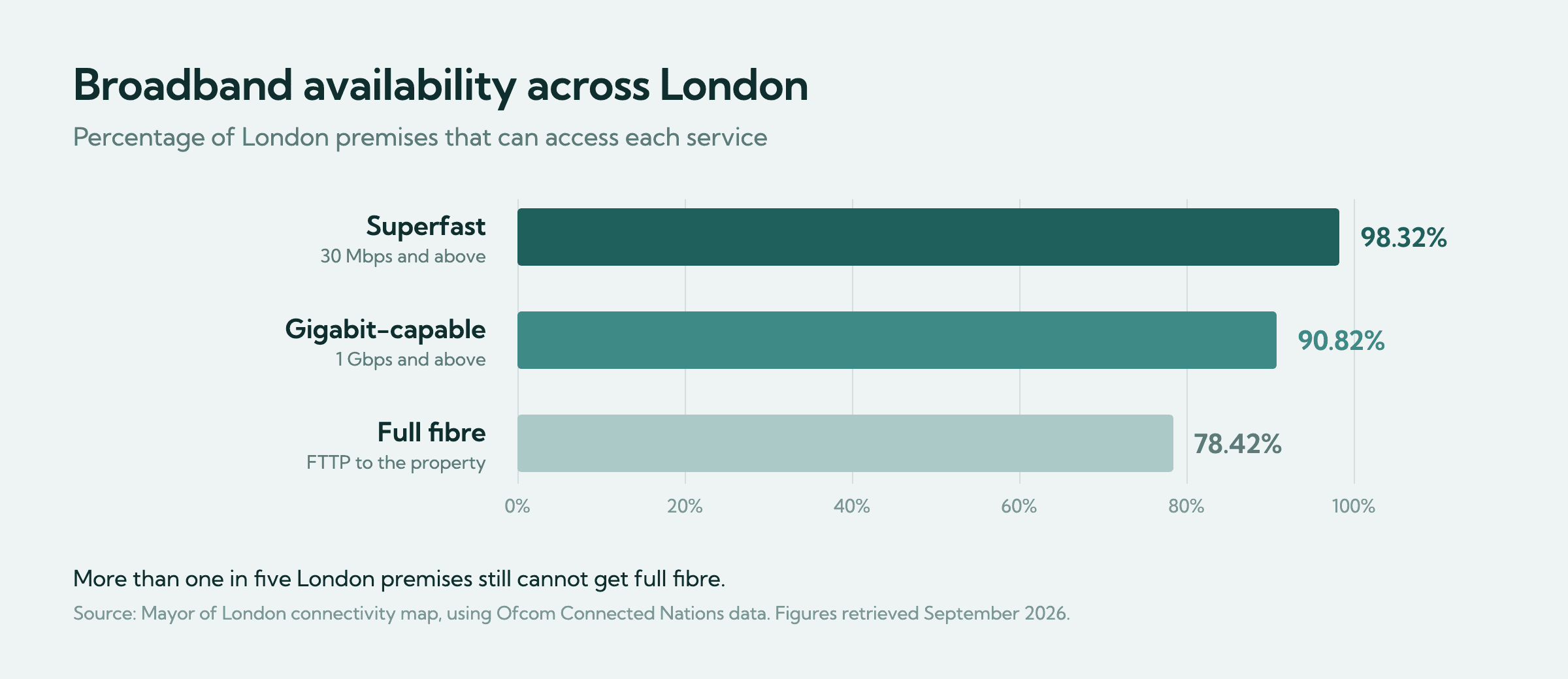
Broadband availability across London premises. Source: Mayor of London connectivity map, using Ofcom Connected Nations data.
There's a deadline in the background here too. The old copper network that carries ADSL and part-fibre connections is being retired, and Openreach has confirmed a final date of 31 January 2027. Londoners still on a copper-based line will need to move to something else regardless.
What fibre broadband alternatives are available to Londoners?
Whether you're unable to access usable speeds over wired broadband or you need an ultrafast connection that hasn't reached your street yet, there are alternatives.
5G mobile broadband is transmitted wirelessly, so there's no need for a cable to be installed at your property. That makes it far quicker to roll out than wired broadband, and it's why it often reaches difficult addresses first. In 5G-connected areas, average mobile broadband speeds sit at 114-205 Mbps - comfortably inside Ofcom's superfast band, with the fastest routers and locations reaching further.
If you want to understand why central London is such a difficult case in the first place, we've covered why options for internet in central London are so bad in more detail.
Don't settle for sub-standard wired broadband. Check whether 5G mobile broadband is available at your address and get the speeds you need, without waiting for anyone to dig up your road.